Showing posts with label Chalk River. Show all posts

Monday, December 24, 2007

At least a month backlog of radioisotopes Western Health Region

It will take at least a month to clear up a backlog of specialized medical tests for western Newfoundland patients, officials said as a nuclear medicine department reopens.

The Western Health regional authority cancelled tests for 48 patients through Western Brook Memorial Hospital in Corner Brook after the Chalk River reactor shut down in November.

The supply of medical isotopes has been restored and officials were expecting to resume tests, including bone and heart scans, on Monday.

"It's wonderful," said Mike Brake, a nuclear medicine technologist who has worked at the Corner Brook hospital for three decades.

"This is the first incident in which we've had an interruption in service, so it's quite unusual for us, but we're so very happy to be back to normal."

Peter Dawe, executive director of the Canadian Cancer Society's Newfoundland and Labrador branch, said the reopening of the department will reduce anxiety for patients waiting for tests.

"It's very important news for people on the west coast, obviously, because you can't treat them and you're absolutely stuck until you get a proper diagnosis," Dawe said.

Western Health has already begun contacting patients to rebook cancelled appointments.

Source: CBC

Related articles:

Chalk River resumes radioisotope production

Chalk River restarting isotope production

Decision made by the Commons: Chalk River "open for the public"

Isotopes Chalk river: production could start very soon

Breaking news: federal government to legislate temporary production of radio isotope at Chalk River

St. Joseph's Health Care to receive scarce medical isotope today

AECL blunder choked supply of key isotope

Ontario reactor shutdown forces cancellation of cancer tests worldwide

Sunday, December 16, 2007

Chalk River resumes radioisotope production

The Canadian government-owned nuclear reactor at Chalk River, Ontario, was back in service this morning and expected to begin producing medical isotopes within four days, Atomic Energy of Canada Ltd said.

The National Research Reactor (NRU), which makes more than two-thirds of global supply of the radioisotopes used in cancer tests, was shut down in November for technical reasons, quickly triggering shortages.

On Wednesday, the Canadian government ordered the AECL, the government-owned nuclear technology company that operates the reactor, to restart the plant.

In spearheading the restart, Canadian Prime Minister Stephen Harper criticized Canadian Nuclear Safety Commission boss Linda Keen for not allowing the reactor to restart earlier this month because of what she said were safety concerns.

"NRU provides medical isotopes for about 25 million diagnoses and treatments a year," David Torgerson president of AECL's research and technology division, said in a statement.

"While we recognize the importance of the reliable production of medical isotopes, our first and foremost commitment is to safety. The NRU reactor has operated safely for the past 50 years and is safer now than ever before."

When injected into the body, the isotopes give off radiation that can be seen by a camera to diagnose cancer, heart disease and other medical conditions.

Chalk River produces medical isotopes for Canadian health-care company MDS Inc. and its MDS Nordion division, which is responsible for about 50 percent of world supply.

In addition to provoking shortages of medical isotopes in Canada and outside the country, the shutdown of the Chalk River reactor sparked a furious debate in parliament and changes at the AECL.

On Friday, Harper said he accepted the resignation of Michael Burns as AECL's chair of the board, effective Dec. 31.

He also announced the appointment of Glenna Carr as the new chair and Hugh MacDiarmid as chief executive officer.

Reuters

Related articles:

Chalk River restarting isotope production

Decision made by the Commons: Chalk River "open for the public"

Isotopes Chalk river: production could start very soon

Breaking news: federal government to legislate temporary production of radio isotope at Chalk River

St. Joseph's Health Care to receive scarce medical isotope today

AECL blunder choked supply of key isotope

Ontario reactor shutdown forces cancellation of cancer tests worldwide

Friday, December 14, 2007

Chalk River restarting isotope production

The nuclear reactor whose shutdown created a critical shortage of radioactive isotopes used to diagnose and treat cancer patients in Canada, the U.S. and many other nations, will resume its operation shortly.

Atomic Energy of Canada Ltd. said yesterday that it expected to begin producing the medical isotopes within seven or eight days.

The announcement came a day after the government scrambled to pass legislation allowing the company to bypass Canada's nuclear safety watchdog and immediately restart the 50-year-old reactor at Chalk River, Ontario.

The reactor was shut down Nov. 18 for maintenance and was scheduled resume operation Nov. 23.
But the Canadian Nuclear Safety Commission ordered an indefinite stoppage after discovering the reactor had been running for a year without the emergency power system being connected to two cooling pumps.

Prime Minister Stephen Harper said there was no risk of a meltdown with the startup. Company executives proposed an interim fix, in which one pump will be hooked up to the emergency power supply.

The reactor produces a radioactive substance called molybdenum-99, which is processed and packaged into canisters that are sold to big hospitals and specialized pharmacies.

The cylinders, in turn, are "milked" for technetium-99, which is used on patients. Technetium-99 is injected into patients undergoing body scans to assess a wide variety of conditions, including cancer, heart disease and bone or kidney illnesses.

Health Minister Tony Clement said he couldn't believe the AECL didn't inform health officials about the extended shutdown.

"I think it's shocking quite frankly," Clement told reporters yesterday. "... If there is an issue of extended shutdown in the future, Health Canada has to be notified immediately."

Source: The Associated Press

Related articles:

Decision made by the Commons: Chalk River "open for the public"

Isotopes Chalk river: production could start very soon

Breaking news: federal government to legislate temporary production of radio isotope at Chalk River

St. Joseph's Health Care to receive scarce medical isotope today

AECL blunder choked supply of key isotope

Ontario reactor shutdown forces cancellation of cancer tests worldwide

Wednesday, December 12, 2007

Decision made by the Commons: Chalk River "open for the public"

The Commons have decided last night to restart Ontario's Chalk River nuclear reactor and resume the production of medical radioisotopes.

Health Minister Tony Clement said this decision balances safety issues at the plant with the urgent need for the product.

The government introduced emergency legislation last night that will compel the plant to restart operations immediately, at least for 120 days.

Atomic Energy of Canada Ltd. shut down the plant for scheduled maintenance last November. The closure was then extended when serious safety concerns were discovered by the Canadian Nuclear Safety Commission, the federal watchdog for the industry.

Last night's bill allows the plant to restart, but suspends the CNSC's oversight of the Chalk River facility.

"A reasonable decision," according to Clement.

The commission made its decisions based on concerns from scientists and engineers over the system used to cool the reactors, and the possibility of a meltdown in an emergency situation.

But Clement said the government's priority is providing the isotopes to patients who need them.

"In terms of balancing that risk with the risk of cancer patients and heart patients who will not be able to get diagnosis or not be able to get therapy, I think the House of Commons made the right decision and approved the startup of the reactor," Clement told CTV's Canada AM today. (click to see video)

He said the government expects the plant to once again be producing usable isotopes within six to eight days.

The bill still needs to be passed by the Senate, which will likely happen today.

Green Party Leader Elizabeth May called for an inquiry into exactly what took place leading up to last night's decision.

She said Prime Minister Stephen Harper turned the reactor shutdown into a partisan issue and undermined Canada's nuclear regulator.

"Yesterday in the House, he attacked the Canadian Nuclear Safety Commission which is the regulatory body that oversees nuclear safety, referring to them as Liberal appointments and charging the Liberal party was getting in the way of people getting their medical isotopes," May told CTV's Canada AM. (click to see video)

"This was a moment for statesmanship, this is when the prime minister should have called on all parties to work together in the interests of Canadians to protect the supply of radioactive isotopes."

She said the situation sets a dangerous precedent for other Canadian communities that host nuclear reactors.

"These are experts in nuclear safety and the chairperson Linda Keen has now been undercut by the prime minister," May said.

"So the next time Canadians living near a nuclear reactor should be concerned if there's a safety defect in a reactor, AECL is going to thumb their nose at the regulator and know the prime minister is going to come to their defence and blame the regulator?"

The Liberals had threatened to refuse to give the bill the unanimous support necessary to bypass the legislative process.

But all of the political parties eventually agreed to fast-track the legislation through the House and Senate.

MPs passed the vote late Tuesday night, with the NDP and Bloc Quebecois backing it.

The Liberal-dominated Senate, which also agreed to stay late, was expected to put the bill to a vote by early today.

CTV

Editor:

"Isn't this political system just great? Although you might not agree with the decision, at least some real decisions are being made!"

"I wonder though, who's going to pay the bill if there's going to be a meltdown!"


Related articles:

Isotopes Chalk river: production could start very soon

Breaking news: federal government to legislate temporary production of radio isotope at Chalk River

St. Joseph's Health Care to receive scarce medical isotope today

AECL blunder choked supply of key isotope

Ontario reactor shutdown forces cancellation of cancer tests worldwide

Tuesday, December 11, 2007

Breaking news: federal government to legislate temporary production of radio isotope at Chalk River


CTV reports that the federal government is set to introduce emergency legislation later today to compel the Chalk River nuclear reactor to restart for 120 days to allow the production of medical radioisotopes.

The National Research Universal (NRU) reactor in Chalk River, Ont., which is operated by Atomic Energy Canada Ltd. (AECL) was closed for repairs on Nov. 18.

The Canadian Nuclear Safety Commission (CNSC) has said several new safety standards must be met before the reactor can be reopened. The repairs have taken longer than expected, leading to radioisotope shortages throughout North America.

That has delayed diagnostic testing, therapies and surgeries tremendously.

More than two-thirds of the world's medical isotopes are produced at the publicly-owned reactor.

CTV reports further that if the legislation passes, the reactor will be allowed to re-open for three months to resume production of the radioisotopes.

CTV

Related articles:

St. Joseph's Health Care to receive scarce medical isotope today

AECL blunder choked supply of key isotope

Ontario reactor shutdown forces cancellation of cancer tests worldwide

Monday, December 10, 2007

St. Joseph's Health Care to receive scarce medical isotope today

St. Joseph's Health Care has been promised a precious shipment of a scarce medical isotope to be received today.

The nuclear material will be used for breast cancer surgeries and bone scans for cancer.

"It's going to allow us to handle our most urgent patients," hospital spokesperson Betty Dann said last Thursday.

St. Joseph's, London Health Sciences Centre and hospitals across the region have been caught in the worldwide shortage of the medical isotope supplied from a reactor in Chalk River, ON.

The radioactive isotope is injected into a patient's vein and can be captured by a sophisticated camera.

(Read more here and here)

Hundreds of patients in the London area have had their cancer and cardiac tests rescheduled last week because the aging Atomic Energy of Canada Ltd. reactor has been shut down longer than expected for maintenance.

"The partial isotope shipment expected on Monday, will allow St. Joseph's to scan eight patients," Dann said.

"If St. Joseph's patients haven't been notified their appointment has been changed, they should keep it," Dann said.

St. Thomas Elgin General Hospital usually does 10 to 15 tests a day with the isotope, plus emergency cases.

Last week, the hospital has been receiving enough for only two scans a day.

"We are able to do a dose for a patient that needs a lung scan and a dose for a patient that needs a cardiac scan each day," said Anita Grant, the hospital's director of patient care.

Meanwhile, the federal government is demanding the maker of the crucial isotopes sort out technical problems that have crippled production....................................

London Free Press

".......................................................To be continued"

Related articles:

AECL blunder choked supply of key isotope

Ontario reactor shutdown forces cancellation of cancer tests worldwide

Friday, December 7, 2007

AECL blunder choked supply of key isotope

Or: Ontario reactor shutdown forces cancellation of cancer tests worldwide, Part 2 (click here for Part 1)

Management mistakes caused the current breakdown in Canada's supply of critical medical isotopes, says the boss of the Chalk River nuclear reactor that makes the isotopes.

Atomic Energy of Canada Ltd. senior vice-president Brian McGee told the country's nuclear safety watchdog here yesterday that the radioisotope-producing National Research Universal (NRU) reactor will likely be shut down until late this month or early January to bring it up to current safety standards.
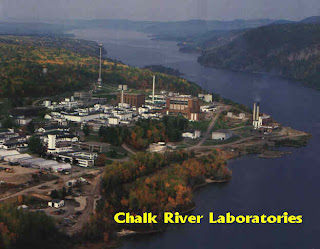
Similar management and engineering blunders also mean a new facility intended to replace that 50-year-old reactor is six years behind schedule, official documents show, with no isotope production expected until the end of next year.

The lengthy NRU shutdown and lack of backup production mean a fresh supply of radioactive materials essential to diagnosing and treating cancers won't flow to hospitals across North America until the second week of January, McGee said during a tempestuous appearance before the Canadian Nuclear Safety Commission.

Commission president Linda Keen criticized AECL for suggesting that the particular safety upgrades were merely optional and not a strict condition of the reactor's operating license.

"This is absolutely revisionist," said the visibly upset Keen. "This should have been done, and it was the clear expectation of the commission that it would be done. You are, and were, in violation of your licenses given to you by Canadians."

"The safety upgrading was supposed to have been completed by the end of 2005 but AECL officials didn't realize this was a strict condition of the reactor's operating license," McGee said.

Instead, they thought the upgrading could be phased in throughout 2008 during the four-day shutdowns scheduled monthly for routine maintenance.

Despite repeated questioning by members of the safety commission, McGee did not explain how AECL managed to so badly misinterpret its license obligations. Senior commission staff told the hearing the conditions were spelled out in documents stretching back 10 years.

The upgrade would connect two pumps to an emergency power supply designed to work even if the Chalk River reactor is hit by a major earthquake. The pumps circulate the heavy water that prevents the reactor from overheating. Although the NRU also boasts other safety systems, the earthquake-resistant cooling system is considered a key part of the defence against a possible core meltdown.

The current NRU shutdown began Nov. 18 for four days of routine maintenance. By Nov. 20, however, AECL and commission staff realized that the emergency power supply was supposed to have been put in two years ago, but hadn't been.

"I can't tell you why we didn't recognize the upgrades were required," McGee said.

The upgrading controversy is the latest in a series of missteps that have plagued attempts to protect Chalk River's position as the world's leading producer of life-saving medical isotopes.

An estimated 45 per cent of current world production of molybdenum-99 comes from the NRU. Moly-99 has a half life of only 66 hours and must be shipped daily to hospitals, where it is used to generate the radioisotope technetium-99, employed in four out of five nuclear medicine procedures.

But a new isotope facility intended to replace the aging reactor has suffered a series of design errors, engineering foul-ups and slipshod testing, all extensively documented at the nuclear safety commission.

At one point, AECL concealed safety problems from the watchdog for almost three months.

It was originally budgeted at $160 million and scheduled to begin operations in 2002. No current cost figures have been made public.

TheStar

Why am I not surprised...............................?

Related article:

Ontario reactor shutdown forces cancellation of cancer tests worldwide

Tuesday, December 4, 2007

Ontario reactor shutdown forces cancellation of cancer tests worldwide

CBC News - Thousands of patients in Canada, the U.S. and other countries are having their medical tests postponed because an Ontario nuclear reactor that produces radio isotopes for nuclear medicine was shut down for repairs.

The government-run Chalk River reactor supplies more than two-thirds of the world's demand for medical radio isotopes, which are used to diagnose cancer and cardiovascular diseases.

Once injected into patients, the radioisotopes allow nuclear imaging equipment to produce detailed scans of the body.

But the Chalk River reactor was closed for scheduled repairs two weeks ago, causing a cross-country shortage of radioisotopes. During the maintenance check, regulators found more problems to repair than expected.

Atomic Energy of Canada Ltd., which owns the reactor, said it won't be operating at full capacity for another 10 days.

About 150 seriously ill Nova Scotians had their medical tests canceled this week in Halifax and Sydney. Halifax nuclear medicine specialist Dr. Andrew Ross said he has already canceled tests for 100 patients and expects to cancel 100 more next week.

"It's an absolutely devastating turn of events for us," said Ross, of Halifax's Capital Health.

Without the radioactive injections, the department's scanning machines can't be used.

"This is the first full-scale interruption that I have experienced in my 20 years of practice," he said.

Nuclear medicine doctors say the biggest frustration is that there was no contingency plan in place before the reactor shut down. Radioisotopes can't be stockpiled because they have a short shelf life and there are only a few suppliers in the world.

Replacement reactors on hold

"Seeing as this shortage is going on for longer than expected, there's definitely going to be issues," said Dawn Marie King of Toronto's University Health Network.

"We are held hostage by it, to be frank."

A federal plan to build two replacement reactors has been on hold for 10 years.

"The plans are all done. It's just a matter of getting the regulatory approvals and the things built and once that happens, this kind of disaster should be far far less likely to happen to us," Ross said.

"Another one of those cases where everyone involved could have realized that repairing something might take longer than you think. That's why plan B-s have been invented!

The problem with maintenance (due) is that you never know what you're going to find. It's an unwritten law in any kind of field, i.e. plumbing, automotive, HVAC etc. to expect and plan for the worst. That's no rocket-science!

Also, 10 years to build a backup plan........ isn't that waiting for trouble to happen?!"