Showing posts with label hospitals. Show all posts

Monday, December 24, 2007

At least a month backlog of radioisotopes Western Health Region

It will take at least a month to clear up a backlog of specialized medical tests for western Newfoundland patients, officials said as a nuclear medicine department reopens.

The Western Health regional authority cancelled tests for 48 patients through Western Brook Memorial Hospital in Corner Brook after the Chalk River reactor shut down in November.

The supply of medical isotopes has been restored and officials were expecting to resume tests, including bone and heart scans, on Monday.

"It's wonderful," said Mike Brake, a nuclear medicine technologist who has worked at the Corner Brook hospital for three decades.

"This is the first incident in which we've had an interruption in service, so it's quite unusual for us, but we're so very happy to be back to normal."

Peter Dawe, executive director of the Canadian Cancer Society's Newfoundland and Labrador branch, said the reopening of the department will reduce anxiety for patients waiting for tests.

"It's very important news for people on the west coast, obviously, because you can't treat them and you're absolutely stuck until you get a proper diagnosis," Dawe said.

Western Health has already begun contacting patients to rebook cancelled appointments.

Source: CBC

Related articles:

Chalk River resumes radioisotope production

Chalk River restarting isotope production

Decision made by the Commons: Chalk River "open for the public"

Isotopes Chalk river: production could start very soon

Breaking news: federal government to legislate temporary production of radio isotope at Chalk River

St. Joseph's Health Care to receive scarce medical isotope today

AECL blunder choked supply of key isotope

Ontario reactor shutdown forces cancellation of cancer tests worldwide

The front line warriors in the pending war against the next global epidemic will carry stethoscopes and wear lab coats, and in the case of Dr. Thomas Tsang, spectacles.
And it is likely Hong Kong will be the battleground.

The mild-mannered Tsang is considered one of the world's foremost experts in fighting the devastating Severe Acute Respiratory Syndrome (SARS) virus that killed 299 people in Hong Kong and spread to Toronto in 2003.

Tsang has a huge responsibility on his hands. He is the key doctor in the Hong Kong Special Administrative Region charged with ensuring the next viral outbreak, in whatever form or mutation, doesn't happen.

And if Canadians are to prevent the next tragedy, they would be wise to see what lessons have been learned in trying to stop one of the world's most deadly diseases.

"You never know what's going to happen tomorrow," Tsang said in an interview in his boardroom, which was the initial nerve centre to create a SARS response strategy during the 2003 crisis.
"You have to have a plan ready," he said. "It's not just sufficient to have a plan, you must execute it."
The normally bustling cosmopolitan financial gateway to Asia was at a standstill in 2003. Business and tourism were hardest hit by SARS which infected 1,755 residents and killed 299 from March 11 to June 6 that year.

Health-care workers and officials fought day in and day out to stop the spread of SARS.
Similar scenarios were carried out in Toronto and elsewhere in Canada where 438 people were infected, and 44 died of SARS from Feb. 23 to June 7, 2003.
SARS has been a wakeup call for health-care workers in Toronto.

Dr. Allison McGeer, director of Infection Control at Mount Sinai, said Canadians have learned from the crisis.
"There's been a number of changes in hospitals, such as guidelines for infection control, educating staff in dealing with infectious diseases, strengthening links between public health departments and hospitals, and working together more smoothly," McGeer said.

McGeer says we always have to ask ourselves: "What more can be done?"

Read the full story here

Friday, December 21, 2007

Hospitalists reduce patients' stay in the hospital

Patients cared for by doctors called "hospitalists," who work full-time in hospitals to focus on general patient care, fare slightly better than those cared for by general internists or family doctors, finds a new study.

Hospitalists reduce a patient's average hospital stay by 12 per cent, and modestly lower treatment costs, the study found. But they do not help lower patients' death risk or the chance that they will have to be readmitted.

Hospitalists are doctors who work full-time at hospitals, performing generalist duties traditionally handled by family doctors or internists making rounds.

Though hospitals in Canada are just beginning to make use of "hospitalists", many hospitals in the U.S. have well-established hospitalist programs. In fact, the category has been one of the fastest-growing medical specialties of the past decade in the U.S., according to the Society of Hospital Medicine.

Researchers from Tufts University School of Medicine decided to take the first wide-scale look at hospitalists, to see whether their use saves hospitals time and money.

They followed 75,000 patients admitted to 45 U.S. hospitals between September 2002 and June 2005 for such common conditions as pneumonia, stroke, chest pain, heart attack or heart failure, and urinary tract infection.

As compared with patients cared for by general internists, those under the watch of hospitalists had a slightly shorter hospital stay, about half a day off the average of four days.


Read the full story here

Thursday, December 20, 2007

Premier Nova Scotia wants to allow more private competition in health care

Rodney MacDonald, Nova Scotia's Premier, should be applauded for his openness to a greater role for private competition in health care.
In his recent state-of-the-province address, he said specifically that the provincial government was moving towards a greater role for the private sector in the delivery of publicly funded health services.

For far too long, Canada has been out of step with the rest of the industrialized world in its steadfast opposition to tapping into the competitive market for solutions to our health care woes, to the detriment of both patients and taxpayers alike.

Consider for a moment what Canadians receive in return for this steadfast commitment to the status quo.
Among the 28 developed nations that have universal health insurance programs, Canada ranks third in age-adjusted health care spending as a percentage of GDP.

At the same time, Canadians endure relatively poor access to physicians and medical technologies, while wait times for health care in Canada are not just unacceptably long but are among the longest in the developed world.
Perhaps a closer look at why other countries are getting more for less is in order.

Among the world’s 28 most developed nations that have universal health insurance coverage like Canada, the majority allow private providers to deliver publicly funded services.

All of the nations that outperform Canada across several measures of mortality related to health system performance (Australia, Sweden and Japan) employ private competitive providers in the delivery of publicly funded health care.

Allowing private hospitals to compete for the delivery of publicly funded care is a proven policy that would improve the state of Medicare for all Canadians.

Premier MacDonald’s willingness to sit down and take an honest look at those policies that have worked so well elsewhere in the developed world, bodes well for both patients and taxpayers in Nova Scotia.

Read the full story here

Monday, December 17, 2007

U.K. public health care system flops, unlike Canadian health care system

Most Canadians are proud of their public health care system.

It's paid for by everybody and used by everybody, it pools the cost of treatment and care.

Like every other health care system in the developed world it has its problems but, contrary to the claims of its enemies, it isn't in crisis.
Until recently, Britain has been like Canada.
Canada's National Health Service, despite its problems, is doing a good job and improving. But its future has been put at risk by the introduction of market forces and profit-seeking providers.

Some B.C. politicians and other private health care lobbyists are claiming that U.K. health care privatization is a success. Nothing could be further from the truth.

Britain recently introduced private hospitals, much like B.C.'s private surgical clinics, to carry out the cheap, less-risky operations on generally healthy patients.
In other words, they "cherry-pick" the profitable work and leave the NHS hospitals to care for less healthy people and all the other complex procedures.

Yet operations in these private hospitals cost on average 11 percent more than in public ones. And these profit-seeking companies are a guaranteed flow of funding.
So if their contract specifies 5,000 patients a year and only 4,500 go there, the private hospital gets paid for the full 5,000.

The former chair of the British Medical Association, James Johnson, has said, "I see hospital services destabilized as a result of over-emphasis on the use of the independent sector . . . the money could often have been better spent making greater use of existing NHS capacity."

While the incomes of private sector hospitals are guaranteed, public hospitals have been forced to compete, not just with the for-profit outfits, but with each other. To do that, the government introduced payment by results, the politicians call this "patient focused funding."

The result has been a mess. The new system was supposed to introduce fiscal discipline, but in its first year the NHS overspent its budget for the first time in 60 years. Hospitals cut back on services to clear deficits, resulting in major backlashes against the Labour party government all over the country.

The troubles don't end there.

The introduction of "patient-focused funding" and market forces has increased the proportion of the health budget spent on bureaucracy from four per cent to approximately 15 percent.

If the money is "patient focused," you have to set up and run a system that tracks both the patients and the money.

Preparing bids costs money. Lawyers and accountants have to be paid. Hospitals have to calculate, log and code each patient's costs. Then they have to send off the bills. The purchaser has to check them.

Some bills are challenged, more lawyers and accountants. And clinicians have to divert time from treating patients to tracking paperwork.

When privatization was introduced, it was presented as a solution for reducing waiting lists and costs. But in reality neither the private sector nor the "patient focused" funding are responsible for cutting the waiting lists in the U.K.

The Vancouver Sun

Editor's opinion:

"I think that governments of countries with a public health care system should keep an active eye on competition. They should impose laws on treatment in private health care facilities that compete with public facilities when the particular treatment is covered by the system."

Monday, December 10, 2007

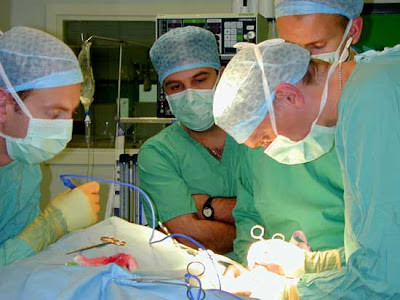
Who's watching you when you're under the scalpel?

Under the cover of blankets and the cloud of anesthetic, surgical patients give themselves over to doctors and nurses charged with their care.

Hours later, they may wake up in a recovery room without realizing someone other than the surgical team was present for their operation.

Representatives from medical device companies sometimes attend surgeries. They offer doctors technical advice on the heart pumps and orthopedic implants and a litany of other products they sell to hospitals.

In Calgary, patients are often unaware of the practice, in part because local hospitals don't require specific consent for a company representative to attend an operation, a fact some observers find troubling.

"You have to be really sensitive to people's privacy and their right to know who's involved with their care," says Dr. Guido Van Rosendaal, a physician and University of Calgary health policy researcher.

Experts say this is just one example of how the influence of device manufacturers and pharmaceutical companies in hospitals reaches further than many patients realize.

Industry's role in hospitals is at the centre of a national ethics debate after a recent Canadian Medical Association Journal article examined a B.C. health authority's new policy around sales representatives in its medical facilities.

The journal reported that Fraser Health brought in the rules after discovering some pharmaceutical sales people were paying surgeons an honorarium or educational grant to allow them to attend surgeries, a practice that is prohibited in Calgary.

Still, the changes at Fraser Health have some observers taking a close look at what industry practices are allowed in Calgary hospitals.

"There's a larger question in terms of what really is the role of sales reps in hospitals," says Barbara Mintzes, an assistant University of British Columbia professor, who studies pharmaceutical marketing practices. "Are some of these promotional activities leading to less appropriate patient care?" But the association representing Canada's research-based pharmaceutical companies argues their sales representatives have a role to play in medical facilities.

"We're making sure health-care professionals know the best information about prescription medications," says Russell Williams, president of Rx & D.

The debate follows the new Fraser Health policy, instituted this fall, that stops sales representatives from leaving samples of new drugs and other products at hospitals. It also bans salespeople from clinical areas such as operating rooms, unless they have permission.

The Calgary Health Region has a similar rule prohibiting pharmaceutical salespeople from meeting with physicians in any patient-care areas of hospitals. Representatives are not allowed to leave free samples of new products in CHR hospitals.

But Fraser Health's policy goes further than Calgary's, requiring vendors to receive an identification badge and "certification" when they arrive at a hospital.

The CHR has no such central intake process for salespeople, though officials concede some representatives occasionally wander into areas of the hospital where they are not allowed.

Steve Long, the CHR's director of pharmacy integration and strategic programs, says the health region contemplated introducing such controls, but decided against it because "we don't see there's an issue or problem." Calgary's policies also differ in one other significant way: CHR hospitals do not require explicit patient consent for a vendor to attend surgery, which is mandatory in Fraser Health hospitals.

Experts like the University of Calgary's Van Rosendaal say local hospitals should reconsider this practice.

CHR officials say vendors follow procedures to protect patient privacy and are only present in operating rooms to provide technical assistance.

"A vendor wouldn't be allowed into the room before a patient is draped and they talk about confidentiality," says Shanda Naylor, the CHR's director of perioperative services.

Officials with Rx & D, the association that represents the country's 50 research-based pharmaceutical companies, say they've banned gifts such as buying a round of golf for a doctor.

"We don't pay for access to medical professionals," says Williams of Rx & D.

Rx & D does permit companies to sponsor training activities for medical professionals and some Calgary doctors say they have little choice but to rely on such support for continuing medical education.

Dr. Debra Isaac, director of cardiac transplants for CHR, says sponsorships from industry allow her to hold training events where she can rent a venue, bring in speakers and even serve a meal. A session in rural Alberta, for example, might teach small-town doctors about treating heart failure.

Without the industry sponsorships, Isaac said, the events wouldn't happen.

"There's just no government funding, no hospital funding," says Isaac. "At this point, we'd be very limited without it." Experts like Mintzes say more public funding should be available to ensure continuing medical education is conducted at arm's length from pharmaceutical companies.

Mintzes also believes industry's self-regulation is problematic, arguing there have been cases where pharmaceutical companies paid for access to doctors, which is prohibited by Rx & D's code.

For now, however, it's left to industry and healthcare providers to find the right balance.

In Calgary, health officials say they have a strong set of rules in place to govern physicians' involvement with pharmaceutical companies.

Calgary Herald

Editor:

Steve Long, the CHR's director of pharmacy integration and strategic programs:
"we don't see there's an issue or problem."

So don't we, after all: we're unconscious!